Healthcare recruitment outsourcing exists because recruiting is a separate occupation, not a spare-time task. When a practice assigns hiring to an office manager who already runs the clinic, both jobs degrade. The hidden cost is not the slow hire. It is everything the manager stopped doing while sourcing, plus the records nobody is keeping.
Every practice under about fifteen people runs the same way. The office manager handles scheduling, payroll questions, vendor calls, patient escalations, and, somewhere in there, hiring.
Nobody decided this. It happened because the role was open and she was the one who noticed.
Most practices never name it as a problem, which is why healthcare recruitment outsourcing gets dismissed as an expense rather than considered as a fix. So let us name it properly, with numbers.
Recruiting Is a Job. You Gave It to Someone Who Already Has One.
This is not a metaphor. The Bureau of Labor Statistics tracks recruiting as its own occupation.
Human resources specialists had a median wage of $75,940 as of May 2025, and BLS defines the work plainly: recruit, screen, and interview job applicants, check references and backgrounds, and refer qualified candidates. Recruitment specialists are listed as a subset who source, test, contact references, and extend offers.
That is a trained discipline with its own labor market. It is also, in most small practices, a task added to somebody’s Tuesday.
Here is the part that makes it official. BLS lists the duties of medical and health services managers as including “recruit, train, and supervise staff members,” alongside budgets, compliance, scheduling, and facility operations. Median pay is $123,860 as of May 2025, or about $59.55 an hour.
So the job was assigned. No time was created to do it. That is the whole problem in one sentence.
The Cost Nobody Puts on the Spreadsheet
Practices decline outsourcing because the fee is visible and the alternative feels free. It is not free. It is unpriced.
What the hours actually cost
Filling one support role honestly takes 20 to 30 hours: writing the spec, posting, sorting applications, screening calls, scheduling interviews, chasing references, and managing the offer.
Run the math conservatively. Even at a practice manager salary well below the BLS median, say $80,000, that is roughly $38 an hour loaded. Twenty-five hours is about $950 of management time per hire, before a single dollar goes to a job board.
That number is not the point, though. The next one is.
What stops while she recruits
Those 25 hours come out of something. In a small practice they usually come out of the highest-value, least-urgent work: the credentialing renewal nobody chased, the denial batch that aged past appeal, the schedule template that would have cut no-shows, the new hire onboarding that got compressed into an afternoon.
That is the real invoice. It does not arrive, which is exactly why nobody adds it up.
A worked example
A four provider clinic loses its front desk lead in March. The office manager absorbs the hiring. She writes the posting, screens applications between patient calls, and fills the seat in nine weeks.
During those nine weeks, two provider credentialing renewals slipped, a denial batch aged past one payer’s appeal window, and the new hire’s onboarding was compressed into a single afternoon because the manager was already behind.
The placement fee she avoided was real money. So was everything on that list. Only one of them showed up in the books.
Why This Is Getting Harder, Not Easier
Two figures explain why hiring will not go back to being a light task.
BLS JOLTS counted 1,438,000 open jobs in health care and social assistance in July 2026, against 7,271,000 total nonfarm openings. That is close to one in five open jobs in the country sitting in a single industry group.
And it is structural, not a bad quarter. BLS projects about 1.9 million healthcare job openings every year from 2025 to 2035, counting both growth and replacement.
Read those together and the conclusion is uncomfortable. Hiring is not an occasional interruption to your operations. It is a recurring function you have not staffed.
Not sure whether to outsource or hire internally? Our staffing and recruitment team will map the hours your current process actually consumes before quoting anything. Most practices have never counted them.
The Compliance Exposure of Informal Hiring
This is the part that surprises people, and it is the strongest argument for putting hiring in trained hands.
When recruiting runs out of an inbox and a spreadsheet, nobody is keeping records. But the obligation exists anyway.
The EEOC requires employers to preserve all personnel and employment records for one year, including records relating to job applications. If a charge is filed, the obligation expands: you must preserve records relating to the issues under investigation for the charging party and for similarly situated individuals, until final disposition of the charge or any resulting lawsuit.
Ask yourself a practical question. If someone filed a charge about a hire you made eight months ago, could you produce the applications, the screening notes, and the reason each candidate was passed over?
For most practices running hiring informally, the honest answer is no. Not because anyone did anything wrong, but because nobody was assigned to keep it.
What Healthcare Recruitment Outsourcing Actually Covers
The term is vague, so here is the concrete version. A real engagement takes these off your desk:
- Intake. A structured session that defines the role against the work, not the title
- Sourcing. Active outreach, not just a posting and a wait
- Screening. First-round calls and a work sample, scored on a consistent scale
- Coordination. Interview scheduling, reminders, and candidate communication
- The shortlist. Three to five candidates with scores, reservations, availability, and the funnel math behind them
- Offer support and records. Reference checks, offer management, and a documented, retainable trail
What stays with you is the only part that should: meeting the final candidates and making the call.
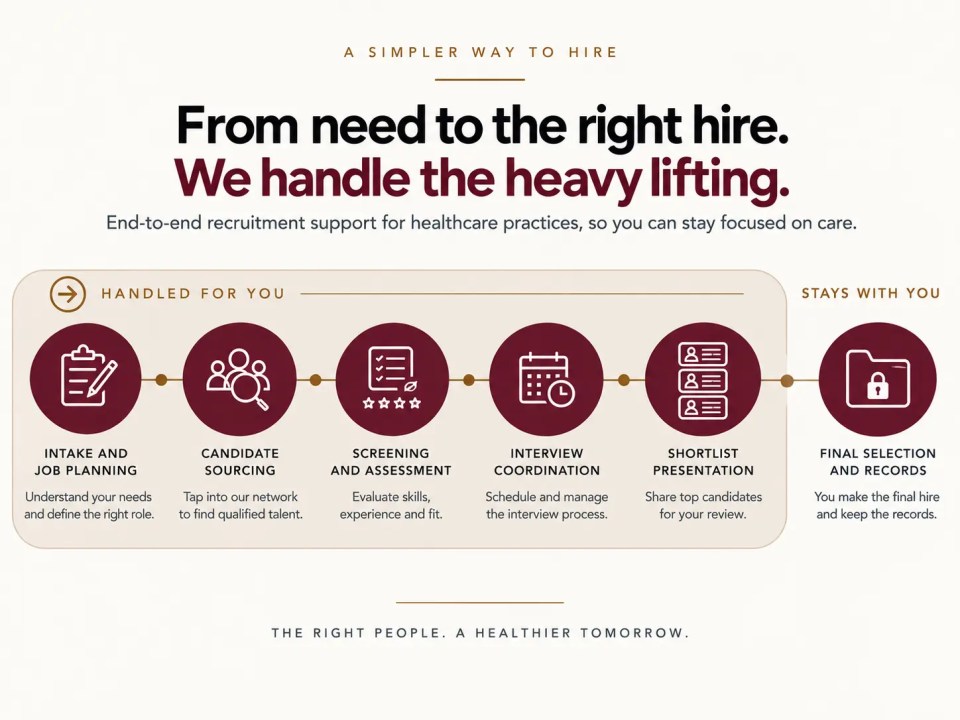
That division is the point. You are not outsourcing judgment. You are outsourcing the forty hours of work that produce the three people worth judging.
The Enterprise Version, Scaled Down
Multi-site groups reached this conclusion years ago. They do not ask practice administrators to recruit. Sourcing and first-round screening sit with a recruiting function, internal or outsourced, and the administrator receives a scored shortlist.
The logic does not depend on size. A three provider clinic does not need a talent team. It needs somebody other than the person running the clinic to own the first forty hours.
If you are evaluating partners, the five questions that expose a weak staffing agency will sort most of the market quickly. For the market data to support an internal business case, our 2026 healthcare support staffing numbers are sourced and linked.
Three signs hiring has outgrown your office manager
- Any role has taken more than six weeks to fill, twice in a row
- You cannot say how many people applied to your last opening
- Nobody could produce the screening notes for a hire made six months ago
Any one of these means the function exists and nobody owns it.
The Bottom Line
Your office manager is not bad at recruiting. She is doing it in the gaps between two other jobs, in a market with 1.4 million open healthcare roles, without the records a regulator would expect.
Before you decide outsourcing is too expensive, count the hours your current process consumes and name what those hours displaced. Then compare.
This article is general information, not legal advice. Recordkeeping and employment obligations vary by employer size and state, so confirm your requirements with employment counsel.
Want that count done for you? Book a 15 minute call. Bring your last open role and we will walk through where the hours went and what a shortlist would have cost instead.
FAQs
1. What is healthcare recruitment outsourcing? It is handing the front end of hiring to a specialist firm: intake, sourcing, first-round screening, interview coordination, and a scored shortlist, plus offer support and a documented record trail. What stays with you is meeting the final candidates and making the decision. You are not outsourcing judgment, you are outsourcing the roughly forty hours of work that produce the three people worth judging.
2. Should a practice manager handle recruiting? BLS lists “recruit, train, and supervise staff members” among the duties of medical and health services managers, so formally yes. Practically, the problem is that no time is created for it. Recruiting is tracked separately as its own occupation, with human resources specialists at a $75,940 median wage as of May 2025. Assigning both sets of duties to one person means the lower-urgency one gets done in gaps.
3. How many hours does it take to fill one support role? Typically 20 to 30 hours across writing the spec, posting, sorting applications, screening calls, scheduling interviews, checking references, and managing the offer. At a conservative $38 an hour loaded for a practice manager, that is roughly $950 of management time per hire before any job board spend, and it does not count what those hours displaced.
4. What records am I required to keep when hiring? The EEOC requires employers to preserve all personnel and employment records for one year, including records relating to job applications. If a charge is filed, the obligation expands: you must preserve records relating to the issues under investigation for the charging party and similarly situated individuals until final disposition of the charge or any lawsuit. Informal hiring run from an inbox rarely satisfies this.
5. Is outsourcing recruitment cheaper than hiring internally? It depends on what you compare. Practices usually compare a placement fee against zero, because internal hours are unpriced. The honest comparison is the fee against the management hours consumed plus the value of the work those hours displaced, such as a slipped credentialing renewal or a denial batch that aged past its appeal window. Count both before deciding.
6. Why is healthcare hiring getting harder? It is structural rather than cyclical. BLS JOLTS counted 1,438,000 open jobs in health care and social assistance in July 2026 against 7,271,000 total nonfarm openings, close to one in five open jobs nationally. BLS also projects about 1.9 million healthcare job openings a year from 2025 to 2035, counting growth and replacement. Hiring is a recurring function, not an occasional interruption.
7. How do I know when hiring has outgrown my office manager? Three signs. Any role has taken more than six weeks to fill twice in a row, you cannot say how many people applied to your last opening, or nobody could produce the screening notes for a hire made six months ago. Any one of them means the function exists and nobody owns it.