Here’s a scenario that plays out constantly in 2026: a founder hires a virtual assistant who lists “ChatGPT, Zapier, HubSpot” on their resume. Two weeks in, it becomes clear they can open those tools, but they can’t actually build anything with them. They can’t write a prompt that produces a usable output on the first try. They can’t build an automation that handles lead follow-up without breaking every three days. And they definitely can’t catch a confidently wrong AI-generated stat before it goes out in a client email.
This is the real problem when you hire an AI virtual assistant in 2026. The market is flooded with candidates who claim AI fluency. Most of them mean they’ve used AI. That’s not the same as being able to run it inside your operations.
This guide is for founders and operators who have been burned or want to avoid being burned, and are ready to hire someone who can actually build and manage an AI-powered operation from day one.
What an AI-Fluent VA Actually Does (and Why It’s Different)
The easiest way to understand the difference is to look at the same task handled two ways.
A traditional VA spends two to three hours manually formatting a weekly sales report from a spreadsheet. An AI-fluent VA feeds that same data into an AI tool, generates a polished draft in minutes, adds human context and judgment, and delivers a better output in a fraction of the time.
A traditional VA takes thirty minutes writing up meeting notes. An AI-fluent VA runs a transcription tool, extracts action items and decisions automatically, and has a structured summary logged in your project management system before the call is off the calendar.
The difference isn’t just speed. It’s the ability to build systems around these tasks so they run reliably, and to maintain those systems when they break. That’s the actual definition of AI fluency in an operational context, and it’s what you’re looking for when you hire.
What an AI-Fluent VA Actually Does (and Why It’s Different)
The easiest way to understand the difference is to look at the same task handled two ways.
A traditional VA spends two to three hours manually formatting a weekly sales report from a spreadsheet. An AI-fluent VA feeds that same data into an AI tool, generates a polished draft in minutes, adds human context and judgment, and delivers a better output in a fraction of the time.
A traditional VA takes thirty minutes writing up meeting notes. An AI-fluent VA runs a transcription tool, extracts action items and decisions automatically, and has a structured summary logged in your project management system before the call is off the calendar.
The difference isn’t just speed. It’s the ability to build systems around these tasks so they run reliably, and to maintain those systems when they break. That’s the actual definition of AI fluency in an operational context, and it’s what you’re looking for when you hire.
The 2026 AI-VA Skill Stack Worth Screening For
Not every candidate needs to know every tool. But a genuinely AI-fluent VA in 2026 should be comfortable across at least three layers of the stack:
Generalist AI tools: ChatGPT and Claude are the baseline. The candidate should know when to use which, how to structure prompts for different outputs, and how to iterate when the first result isn’t right.
Automation platforms: This is the real differentiator. Zapier is the most accessible, roughly 7,000+ integrations, minimal technical knowledge required. Make (formerly Integromat) is more powerful for complex workflows. n8n is the most flexible for AI-native automation. A strong candidate knows at least one of these at a working level, meaning they can build a multi-step automation, not just describe how one works.
CRM and business operations tools: HubSpot, GoHighLevel, or industry-specific platforms like Follow Up Boss for real estate teams. The question isn’t whether they’ve heard of these tools, it’s whether they’ve actually configured workflows inside them.
Documentation and knowledge management: Notion AI, ClickUp Brain, Loom for building SOPs that your whole team can actually use.
Demand for AI-enabled skills grew 109% year over year on Upwork in 2025, based on completed-job earnings, not surveys or forecasts. Real spending on real output. The market is already telling you what matters.
5 Mistakes Founders Make When Hiring an AI Virtual Assistant
1. Hiring on Tool Name-Dropping
A resume that lists six AI tools is not evidence of skill. It’s evidence that the candidate knows what to write on a resume. Tool familiarity can be acquired in days. Judgment, verification habits, and the ability to build systems that actually hold up, those take real experience.
2. Skipping the Paid Test Task
This is the single highest-leverage screening move available, and most founders skip it. A fifteen to twenty dollar paid test task, something that mirrors the actual work you need done, will tell you more about a candidate than any interview. Ask them to build a simple automation, triage an email inbox, or set up a CRM workflow. Watch what they produce.

3. Treating the Interview as a Casual Conversation
Structured interviews are roughly twice as predictive of job performance as unstructured ones. Come in with specific, behavioral questions: Tell me about a workflow you built that broke, what happened and how did you fix it? Vague, polished answers signal scripted preparation. Specific, imperfect stories signal real experience.
4. Not Testing for AI Verification Skill
This is the mistake that creates the most operational risk. A 2025 study from the University of Melbourne and KPMG, spanning 48,340 participants across 47 countries, found that 56% of AI users have made a work mistake by relying on unverified AI output, and 66% regularly use AI output without evaluating its accuracy.
An AI-fluent VA is precisely one who treats AI as a confident but fallible tool and builds verification into their workflow. Ask directly: How do you check AI output before it reaches a client? A strong answer names specific steps. A weak one says “I trust it.”
The U.S. Department of Labor’s AI Literacy Framework, released in early 2026, identifies critical evaluation of AI outputs as a core workforce competency, the same standard you should apply when hiring.
5. Confusing “Uses AI” With “Runs AI Operations”
Using ChatGPT to draft emails is not the same as building the automation stack that runs your lead follow-up, maintaining the CRM that your pipeline depends on, and iterating on the systems when the business changes. The first is a productivity habit. The second is a professional skill set. Know which one you’re actually hiring for.
[What Is an AI-Certified Virtual Assistant — And Why It Matters in 2026]
How to Test for Real AI Skill Before You Hire
Give the candidate a paid test task that mirrors the actual work. Here are two examples that work well:
For automation: “Build a Zapier or Make workflow that captures a web form submission, adds the contact to a CRM, and sends a Slack notification to the team. Walk me through what you built and what you would improve.”
For operations: “Here’s an export of 200 emails from our inbox. Using AI tools of your choice, triage them by priority, draft responses to the top five, and flag anything that needs a human decision. Show me your process.”
What you’re evaluating isn’t perfection. It’s how they think, how they iterate, and whether they catch the things that are wrong. Pay particular attention to whether they fact-check AI output before delivering it.
Alongside the test task, ask one direct question in the interview: “Show me a workflow you’ve built from scratch, and tell me what broke.” Experienced operators have specific war stories. Candidates who’ve watched YouTube tutorials do not.
The NIST AI Risk Management Framework identifies workforce AI competency, including the ability to evaluate, verify, and manage AI outputs, as a core operational risk management requirement. The same logic applies to every hire you make who will be running AI tools inside your business.
A Quick Screening Checklist Before You Make the Offer
Before extending an offer to any VA candidate claiming AI fluency, run through these eight questions:
- Can they name and explain at least one automation platform at a working level?
- Did they complete the paid test task without prompting, and did it actually work?
- Can they explain, step by step, how they verify AI output before it goes to a client?
- Did they give specific examples with details, when asked about systems they’ve built?
- Did they show iteration in their test task, or did they submit the first output they got?
- Can they explain what a workflow looks like when it breaks, and how they fixed it?
- Are they honest about what they don’t know yet, and do they have a plan to close that gap?
- Did you verify their identity and past work on a live video call?
Eight checkboxes. Not complicated. But most hires that go wrong skipped at least three of them.
Conclusion: The Standard Has Changed, Hire Accordingly
The bar for “knows AI” has moved. In 2024 it meant using ChatGPT. In 2026 it means building the systems that run your operations and maintaining them when they break. If you’re looking to hire an AI virtual assistant who meets that standard, start with the test task. Everything else is easier to evaluate once you’ve seen them actually do the work.
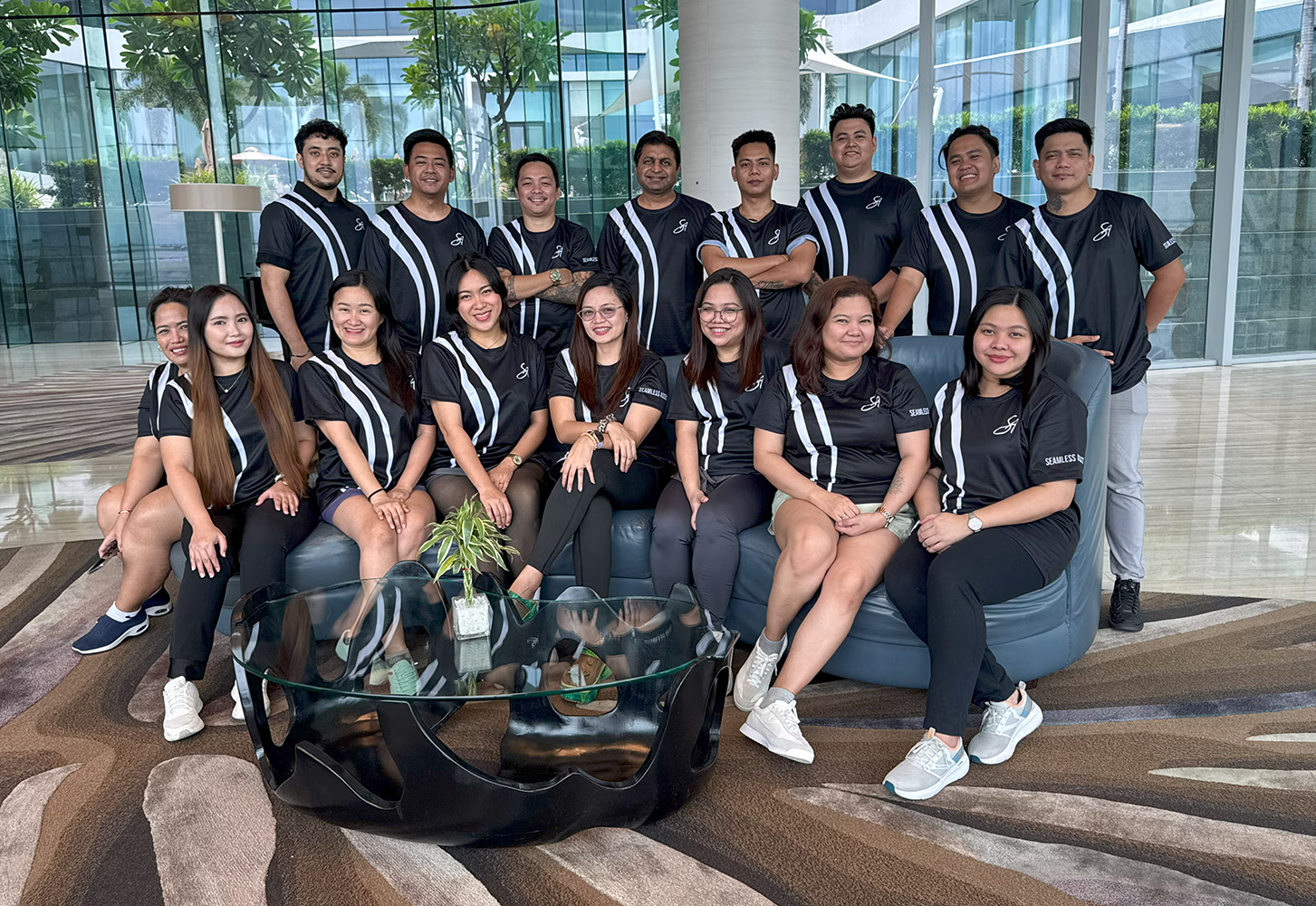
At Seamless Assist, every VA we place goes through a structured screening process built around demonstrated output, not tool name-dropping. Our SAC (Seamless Assist Certified) standard tests for real automation skill, CRM fluency, prompt quality, and the verification habits that protect your operations from AI errors.
[Find out what an AI-certified operations hire looks like for your business →]
Frequently Asked Questions
1. What’s the difference between a regular VA and an AI virtual assistant?
A traditional VA executes tasks manually: scheduling, data entry, email management, document formatting. An AI virtual assistant uses AI tools and automation platforms to complete those same tasks faster, more consistently, and at higher volume and, critically, can build and maintain the systems that run those workflows without requiring your oversight. The output is the same; the operating model is fundamentally different.
2. What AI tools should a virtual assistant know in 2026?
At minimum: one generalist LLM (ChatGPT or Claude), one automation platform (Zapier, Make, or n8n), and one CRM or business operations platform relevant to your industry. For real estate teams, add Follow Up Boss or Lofty. For general business operations, add HubSpot or GoHighLevel. Beyond tools, the most important skill is knowing how to verify AI output, not just produce it.
3. How do I test whether a VA actually knows AI before hiring them?
Give them a paid test task that mirrors your real work. Ask them to build a simple automation, triage an email inbox using AI tools, or set up a CRM workflow. Evaluate how they think, how they iterate, and whether they catch errors in their own output. Follow up in the interview by asking what broke in the last system they built and how they fixed it.
4. Are AI certifications for virtual assistants worth anything?
They’re supporting signals, not proof of capability. No single accredited industry-wide standard exists. Platform certifications from Zapier, HubSpot, or Make tell you a candidate has completed training, they don’t tell you the candidate can build something that holds up in a real business. Demonstrated output in a test task is more predictive than any certificate.
5. What’s the biggest risk of hiring a VA who overstates their AI skills?
Operational failure you don’t see immediately. A VA who can’t build reliable automations creates fragile systems that break unpredictably. One who can’t verify AI output sends errors to clients. Both problems tend to surface weeks in, after you’ve already handed over operational responsibility. The paid test task exists specifically to surface these issues before the hire.
6. How much should I expect to pay for an AI-certified virtual assistant?
Rates vary significantly by geography, experience, and specialization. An AI-fluent VA with demonstrated automation skills will typically command a premium over a generalist. The meaningful comparison isn’t VA cost vs. zero, it’s VA cost vs. the fully loaded cost of a local full-time hire, including salary, payroll taxes, benefits, and onboarding time. For businesses in high-wage cities, the math is usually decisive.
7. What does Seamless Assist’s hiring process look like for AI virtual assistants?
Every VA placed by Seamless Assist goes through our SAC (Seamless Assist Certified) screening process: structured skills assessment, live automation test, prompt quality evaluation, CRM fluency verification, and identity confirmation. We don’t place candidates who can’t demonstrate working output. The certification isn’t a badge, it’s a process with a pass/fail outcome based entirely on what the candidate can actually produce.