If you started your business to build something meaningful, here’s a question worth sitting with: how much of your week is actually spent on work only you can do?
For most founders, the honest answer is uncomfortable. Somewhere between scaling, hiring, and keeping everything running, the role of “founder” quietly becomes the role of “chief everything officer.” You’re approving invoices, chasing leads, answering emails that should have been automated months ago, and manually updating spreadsheets that have no business existing in 2026.
This is how founder burnout starts, not with one catastrophic failure, but with a slow accumulation of operational weight that was never yours to carry in the first place. The good news? AI operations support has made it genuinely possible to offload that weight, systematize your back office, and get back to the work that grows your business.
This article breaks down exactly why founders burn out managing operations, what the research tells us, and how modern AI operations support, combined with AI-fluent talent, changes the equation.
The Real Reason Founders Burn Out (It’s Not What You Think)
Most conversations about founder burnout focus on overwork or stress. And while those are real, they’re symptoms. The root cause is something more specific: decision fatigue from operational noise.
A 2023 study from the American Psychological Association found that chronic workplace stress, the kind that comes from persistent, low-stakes but high-volume demands, is a leading driver of burnout in leadership roles. For founders, that translates directly to operations: the endless stream of scheduling, data entry, client follow-up, vendor coordination, and tool management that accumulates faster than any one person can handle.
The Cognitive Cost of Operational Drag
Every time you answer an email that could have been templated, approve a task that should be automated, or search for a file that should have been organized, you spend cognitive capital. The National Institute of Mental Health recognizes chronic cognitive overload as a meaningful contributor to executive dysfunction and burnout, both of which directly impair the strategic thinking founders need most.
The problem isn’t that you’re working hard. It’s that you’re working on the wrong things, and your brain pays the price for it every day.
The Scaling Trap
Here’s where it gets worse. As businesses grow, operational complexity grows faster. A founder managing a 5-person team might handle operations manually. A founder managing 20 people, multiple service lines, and a growing client base cannot, and yet many try. The result is a ceiling on both personal wellbeing and business growth.
What Operations Actually Eats From Your Week
Let’s be specific. The operational tasks that most reliably drain founder time and energy fall into several categories:

Inbox and communication management: Research from McKinsey Global Institute estimates that knowledge workers spend up to 28% of their workweek managing email alone. For founders, that figure is often higher because they’re copied on everything.
Repetitive administrative work: Scheduling, data entry, status updates, follow-up sequences, document formatting. None of it is complex. All of it is time-consuming.
Tool and systems management: Keeping your CRM updated, managing project boards, reconciling task lists across platforms. This is operational infrastructure that exists to support your team, and yet it often ends up consuming your own hours.
Vendor and client coordination: Especially in service businesses, the volume of back-and-forth communication around deliverables, timelines, and approvals is relentless.
None of these tasks require your strategic judgment. All of them are stealing it.
How AI Operations Support Changes the Model
Here’s where the shift happens. Operational efficiency powered by AI isn’t just about automation for automation’s sake, it’s about building systems that run predictably without your constant input, freeing you to operate as the decision-maker your business actually needs.
There are two layers to this, and both matter:
Automation Infrastructure
The first layer is the technology itself. Workflow automation tools, platforms like Make, Zapier, and n8n can handle significant portions of the operational tasks that currently land on your plate. Lead follow-up sequences, CRM updates, intake forms, invoice triggers, appointment reminders, report generation, these are all automatable.
A properly built automation stack doesn’t just save time. It removes entire categories of decision-making from your week. When a process is systematized, it no longer requires your attention to run correctly.
AI-Fluent Human Talent
Automation handles the predictable. But business operations aren’t always predictable. That’s where the human layer becomes critical and where the bar for “qualified support” has fundamentally changed.
An AI-certified operator doesn’t just complete tasks. They use AI tools to complete those tasks faster, with greater consistency, and with less back-and-forth with you. They build dashboards. They write SOPs that your automated systems reference. They run your morning briefings through AI-generated summaries so you arrive at work already up to speed.
This isn’t a virtual assistant who needs to be managed. It’s an operations partner who uses the same tools you do, often better than you do, so your systems evolve without your constant involvement.
The Compound Effect on Founder Productivity
When automation infrastructure and AI-fluent staff work together, the impact on founder productivity is multiplicative, not additive. You’re not just getting tasks off your plate. You’re building a business that runs whether you’re in it or not, which is, arguably, the most important thing a founder can build.
Real-World Impact: What This Looks Like in Practice
Consider a real estate broker managing six active listings. Before AI-powered operations support, their week looks like this: manually following up on leads, chasing transaction coordinators for status updates, answering the same client questions repeatedly, updating the CRM themselves, and handling administrative tasks that keep them tethered to their inbox from 7am to 9pm.
After implementing automation infrastructure and placing an AI-certified operations specialist:
- Lead follow-up is handled by an automated sequence that triggers on inquiry, personalizes by property type, and escalates only when there’s genuine engagement
- Transaction updates arrive as a daily dashboard briefing, prepared and formatted before the broker’s morning coffee
- Client communication is handled by the operations specialist using AI drafting tools, reviewed and sent in batches rather than on-demand
- The CRM is maintained in real time, with no manual entry required from the broker
The broker’s role shifts from reactive to strategic. They’re reviewing decisions, not making administrative ones. They’re leading their business, not running its back office.
This same model applies across industries, from small business owners managing twenty-person teams to wellness clinic founders drowning in scheduling and billing admin. The operational pattern is nearly identical. The solution is the same.
Founder Burnout Solutions That Actually Stick
There’s no shortage of productivity advice aimed at founders. Most of it addresses symptoms. Sustainable founder burnout solutions address structure.
The founders who successfully escape the operational trap don’t do it by working fewer hours or taking more vacations. They do it by systematizing their business so that growth doesn’t require more of their personal time to sustain.
That means building automation where possible, hiring AI-fluent people who can run and evolve those systems, and establishing clear operating principles that keep the business moving without requiring your input on every decision.
The U.S. Small Business Administration consistently notes that one of the highest-impact things a small business owner can do for long-term sustainability is to reduce personal dependence on themselves for core operations. That’s not a productivity hack, it’s a business architecture decision.
How to Start: A Practical Framework
If you’re currently in the thick of operational overload, here’s a clear starting point:

Step 1: Audit your week. Track where your time actually goes for one week. Most founders are surprised by how much of it sits in tasks that have no business requiring their attention.
Step 2: Identify what’s automatable. Any task that happens on a schedule, follows a predictable pattern, or could be triggered by an event (a form submission, a new lead, a signed contract) is a candidate for automation.
Step 3: Identify what needs a human. Not everything automates cleanly. Client relationships, nuanced communication, and dynamic problem-solving still benefit from human judgment. The question is whether that human needs to be you.
Step 4: Build the stack. This is where most founders stall, because building automation infrastructure while running a business is genuinely hard. The right support system handles this for you, and then stays embedded to maintain and evolve it.
Conclusion: The Business You Actually Wanted to Build
Founder burnout from operations isn’t inevitable. It’s the natural outcome of building a business without the systems it needs to run independently and the longer it continues, the harder the business is to scale and the harder it is for you to lead.
AI operations support isn’t a shortcut. It’s the infrastructure layer that lets you build and lead the way you intended to when you started. Automation handles what’s predictable. AI-fluent people handle what isn’t. And you get back to the work that actually requires you.
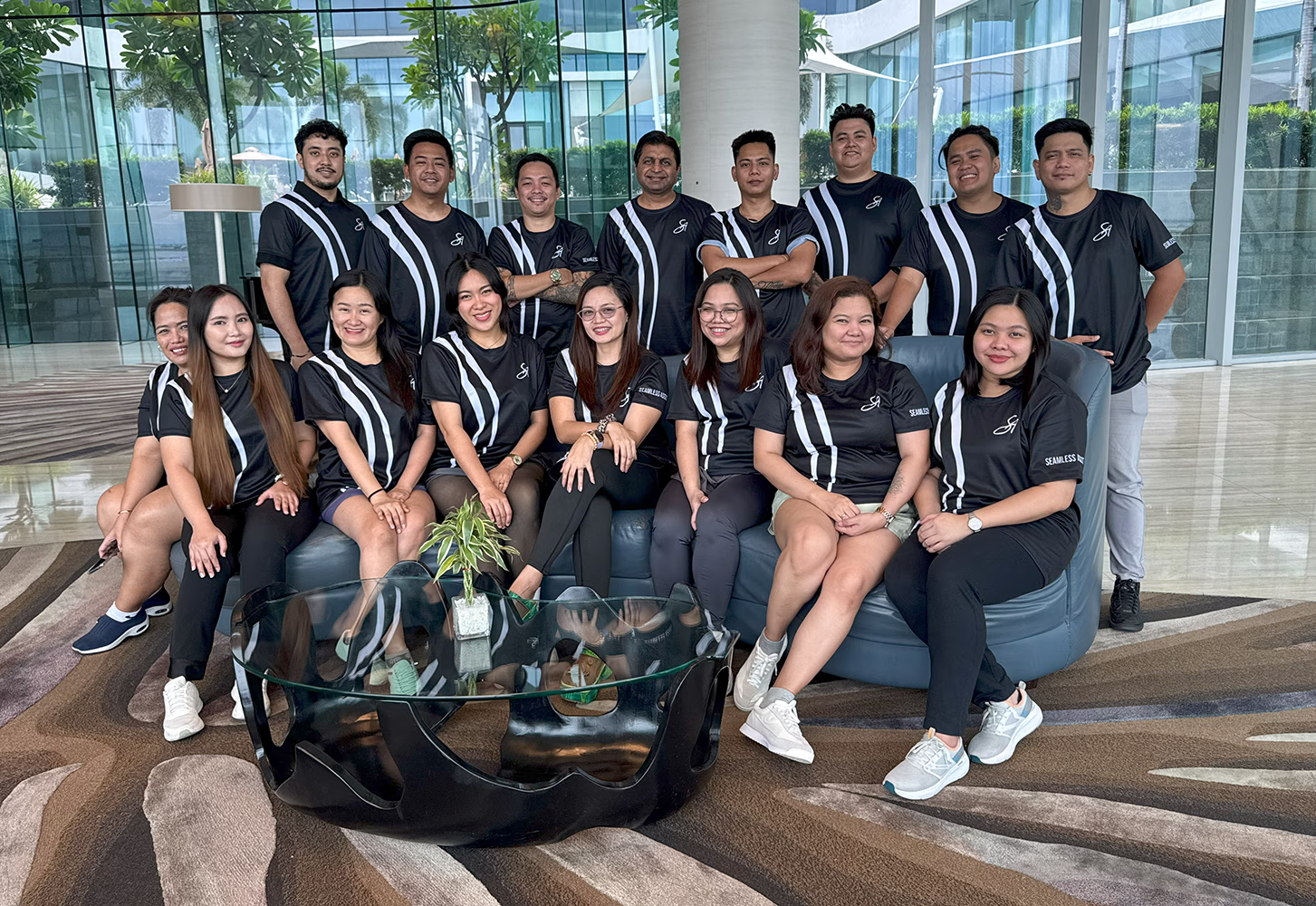
At Seamless Assist, we sit at the intersection of AI automation infrastructure and AI-certified talent. We don’t just place a VA and hand you a login. We build the systems your business needs, then place people who can run and evolve them, so you stop being the glue that holds everything together.
If your week is running you, let’s change that. Explore how Seamless Assist builds AI-powered operations →
Frequently Asked Questions
1. What is founder burnout, and how is it different from general work stress?
Founder burnout is a sustained state of mental and emotional exhaustion driven by the compounding demands of running a business. Unlike general work stress, which may be episodic, founder burnout tends to build gradually from operational overload, too many low-value decisions, too much manual work, and too little time for strategic leadership. It’s addressed not just through rest, but through structural changes to how the business operates.
2. What are the most effective founder burnout solutions for small businesses?
The most sustainable solutions combine two elements: automation infrastructure (systematizing predictable, repeatable tasks) and AI-fluent human talent (operators who can manage the systems and handle what automation can’t). Productivity tools and time-management techniques help at the margins, but structural operational changes are what actually shift the dynamic long-term.
3. How does AI operations support differ from hiring a traditional virtual assistant?
A traditional VA executes tasks. An AI-certified operations specialist uses AI tools to do those tasks faster, more consistently, and with less oversight from you. They can build dashboards, draft communications using AI tools, maintain your CRM in real time, and help evolve your systems over time, not just follow instructions.
4. What types of business operations can actually be automated?
A wide range of operations are candidates for automation: lead follow-up sequences, appointment scheduling, CRM data entry, invoice generation, onboarding workflows, internal status reports, social media scheduling, and client communication templates. The general rule is: if it happens on a schedule or follows a predictable trigger, it can likely be automated.
5. Is AI automation only for large enterprises, or can small businesses use it too?
Automation is highly accessible to small businesses in 2026. Platforms like Make, Zapier, and n8n are designed for non-developers and can be implemented without engineering resources. The challenge for most small businesses isn’t access, it’s knowing where to start and having someone to build and maintain the system. That’s precisely what an embedded AI Engineer or AI-certified VA handles.
6. How do I know if my business is ready for AI-powered operations support?
If you’re regularly doing tasks that feel repetitive, if your team spends significant time on manual data management, or if you find yourself the bottleneck in decisions that shouldn’t require you, your business is ready. The threshold isn’t size; it’s operational pain.
7. What’s the difference between an automation consultant and an embedded AI operations partner?
A consultant delivers and leaves. An embedded AI operations partner, like those placed by Seamless Assist stays in your business, maintains your systems, adapts them as your needs change, and trains your team to use them. The outcome isn’t a completed project; it’s a continuously improving operational infrastructure.